Keeping the faith
How churches can be redeveloped without losing religious life
Years ago, on an April evening, I met with a local architect that specializes in historic adaptive reuse. I wanted to show him this vacant 19th century church, and was hoping we could brainstorm ideas of what it could be next. We walked under row after row of truss work and admired the tall lancet windows. He said, “I think it would make a good church.”
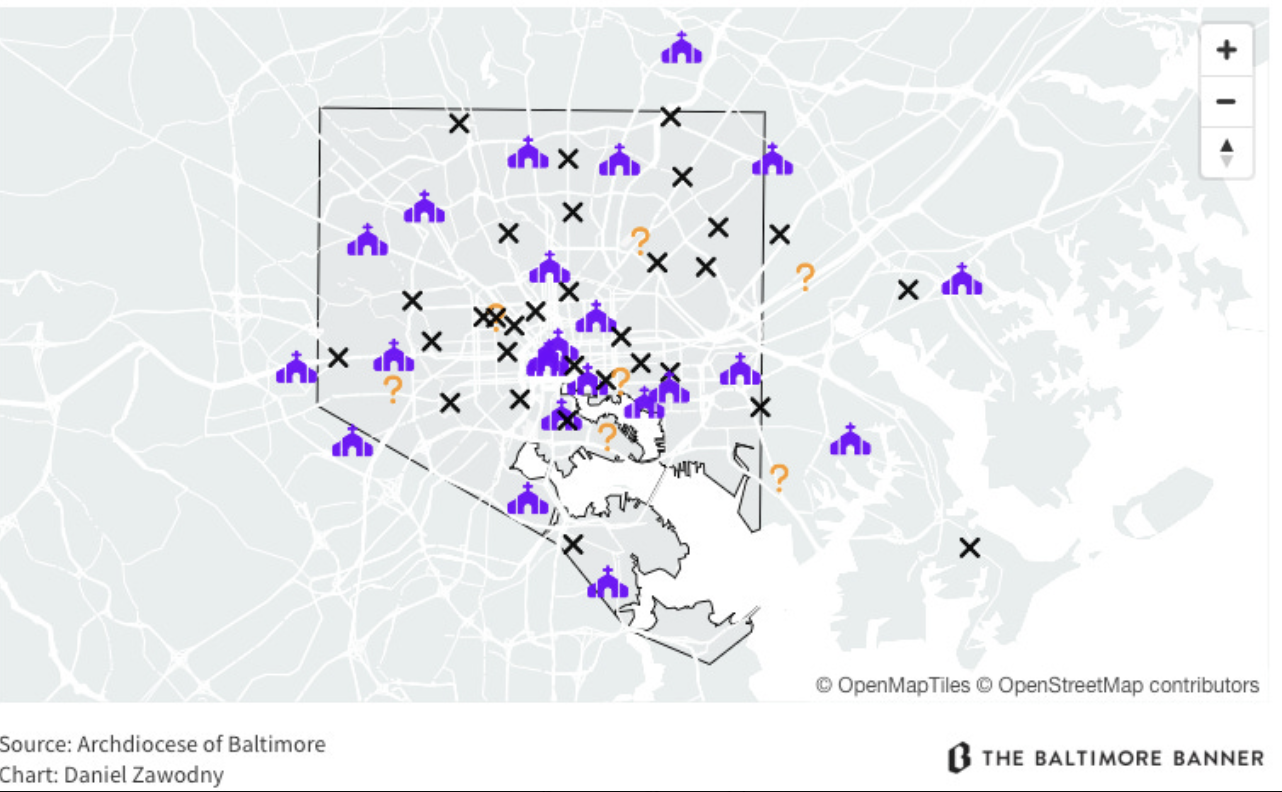
In the last decade the United Methodist Church has closed over thirty churches in the Baltimore-Washington Conference. Now the Catholic Church is beginning to reduce their city parishes from 61 down to 23. It is a painful time for families who prayed in these places for generations.
But there is a path towards redeveloping churches without losing religious service. Here are three case studies in Baltimore where that is happening.
Background
Church closures are often explained as a story of declining attendance, but the problem is with the buildings themselves: they were built for a 19th century life. Congregants used to live a very short walk away. Neighborhoods and social calendars were organized around church life. Many churches were built for ethnic enclaves—Polish, Italian—that have long ago dispersed after fair housing made free movement possible. And the buildings themselves are massive, with the attending maintenance costs.
A congregation of thirty people could do well, and even thrive, in a modern 1,800 SF space. But in a 12,000 SF historic building, with a slate roof, a huge boiler, and antique stained glass… it is only a matter of time before they are forced into a sale.
So how can these challenges be addressed?
Selling Auxiliary Buildings
One proven method church leaders have used forever: subdivide and sell off the adjoining schoolhouses, rectories, offices, and other auxiliary buildings. This reduces underused square feet and eliminates future maintenance costs. The returns are reinvested into the main building and (hopefully) you have taken on a neighbor and partner for shared property problems in the future.
For example, Chase Court, one of our city’s best wedding venues, was once the parish house for Christ Episcopal on Chase and Saint Paul.
In Canton, we were part of the development team for a schoolhouse conversion into 15 apartments. The adjoining church sold us the building because it was no longer needed. And the church is still going strong without it, wrapping up their 152nd year in operation.
Sharing Space
Besides subdivision and sale, there are other ways to dispense with underused square footage. In 2020, I purchased a century old Methodist Church in Coldstream-Homestead-Montebello. The building was beautiful and distinctive, but far too large for a single congregation to maintain. The solution was to make space for two congregations.
The building’s layout made this possible. The main sanctuary is on the second floor, reached by an exterior stone staircase. The first floor contains an open, light-filled dining room with a stage (originally built for theater performances). Each floor has its own prominent entrance that reads as the building’s “front door,” along with independent means of egress. And both spaces comfortably accommodate their congregations, with spare room for offices, classes, and storage.
There have sometimes been challenges, chiefly around coordinating schedules so services and events do not overlap. But the arrangement works. Both religious organizations have operated in the same building for years. For each on their own, it would have been extraordinarily difficult to maintain.
Program-First Redevelopment
UNITE Mount Vernon is showing us something interesting in Baltimore. They have acquired the iconic Mount Vernon United Methodist Church. Although the building was in dire straits, it still had an active congregation that had called the church home for 153 years.
UNITE came into the acquisition with a commitment to keep the congregation going. That obviously limited their options for redevelopment. Rather then rush into a new permanent use, they are market-testing programs and events that can add revenue and keep the church viable. So far these include:
the return of a daycare that previously operated in the lower level
pop-up events such as this one by Ivy Bookshop
concerts! including one this Thursday with Clayton Bryant and Mariah Bonner.
As a 501(c)(3), UNITE’s work is centered around preserving a community asset (and one of Baltimore’s most recognized buildings). The work depends on community donations and local grants. So far it seems Mount Vernon is stepping up.
In Baltimore and throughout the U.S. we are going to see a lot of churches close. Sadly some will be demolished. Others will be repurposed. It is an encouraging sight that some will, even after redevelopment, find ways to keep doors open to congregations for many more generations.