Driving In Xinyang
We visit Xinyang often to see my wife’s family. The urban center of the city has roughly 1.5 million people, and the greater area is 6 million. What passes for a metropolis in most of the world is, in China, a mere exurb of ‘real’ cities like Wuhan (200 kilometers north) and Zhengzhou (300 kilometers south). High school students are encouraged to leave and start their careers someplace bigger.
Xinyang is scenic and the pace of life is relaxed. The Shihe river runs through the city center, under seven connecting bridges. It terminates at Nanwan lake (also the city reservoir), surrounded by jungle mountains. The air is clean (for China) and the surrounding area has beautiful waterfalls, lotus blossom lakes, and maojian tea farm mountains.
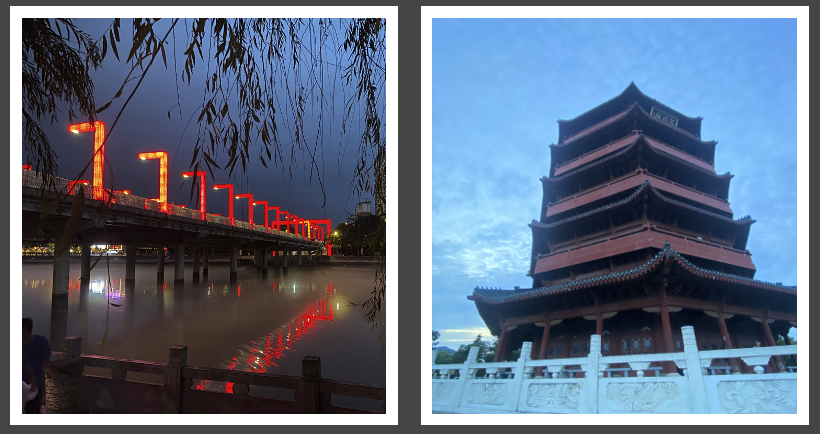
Left: one of the bridges over the Shihe river. Right: It was considered bad luck to live south of the Shihe river. The city consulted a fengshui expert who advised them to build this pagoda. Then the south side could be redeveloped.
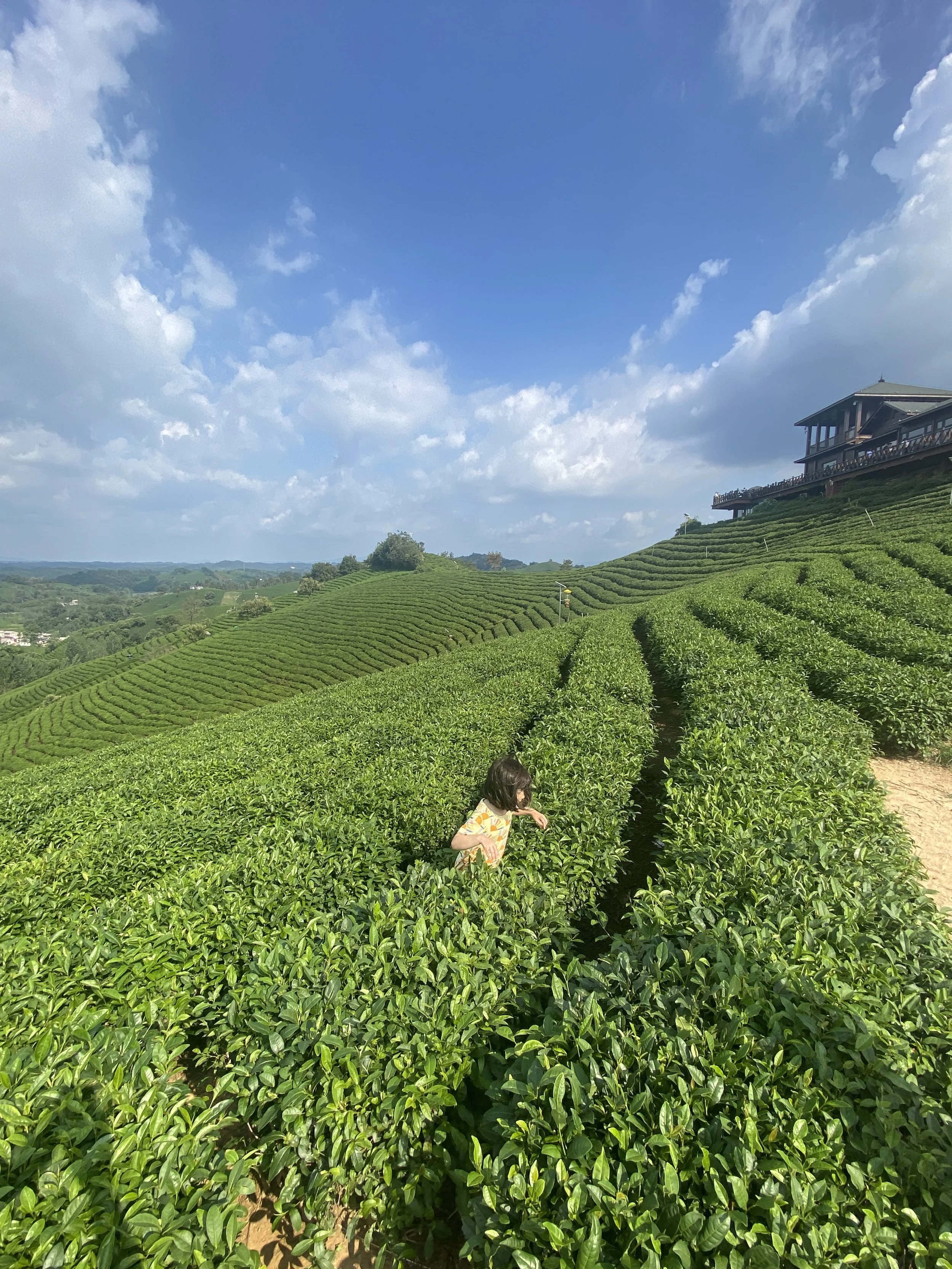
Maojian tea mountains
My in-laws live in Renfang Hutong, on the north side of the river— “Old Xinyang.” On their immediate block there is a dumplings shop, optometrist, tea shop, Haoxianglai convenience store, two bakeries, and the Hemei mall and grocery store. If you turn the other way there are carry-out shops selling zongzi, shaobing, dumplings, ice cream, fresh fruit. Around the corner is an art school where my daughter took classes. Even the alleys have micro-storefronts less then 150 SF, where you can get a haircut or eat breakfast reganmian. And there are usually a half dozen sanluoche parked on the sidewalk, selling fresh watermelons, eggs, peanuts, or offering to cut keys or sharpen your knives.
At night the riverside has a meandering night market with hundreds of cart vendors serving street food. It is a romantic spot for young people and the city has played this up by installing several “date night” themed sculptures and light installations. Shihe Park is a short walk away and is full of people most summer evenings, strolling, dancing, or playing cards.
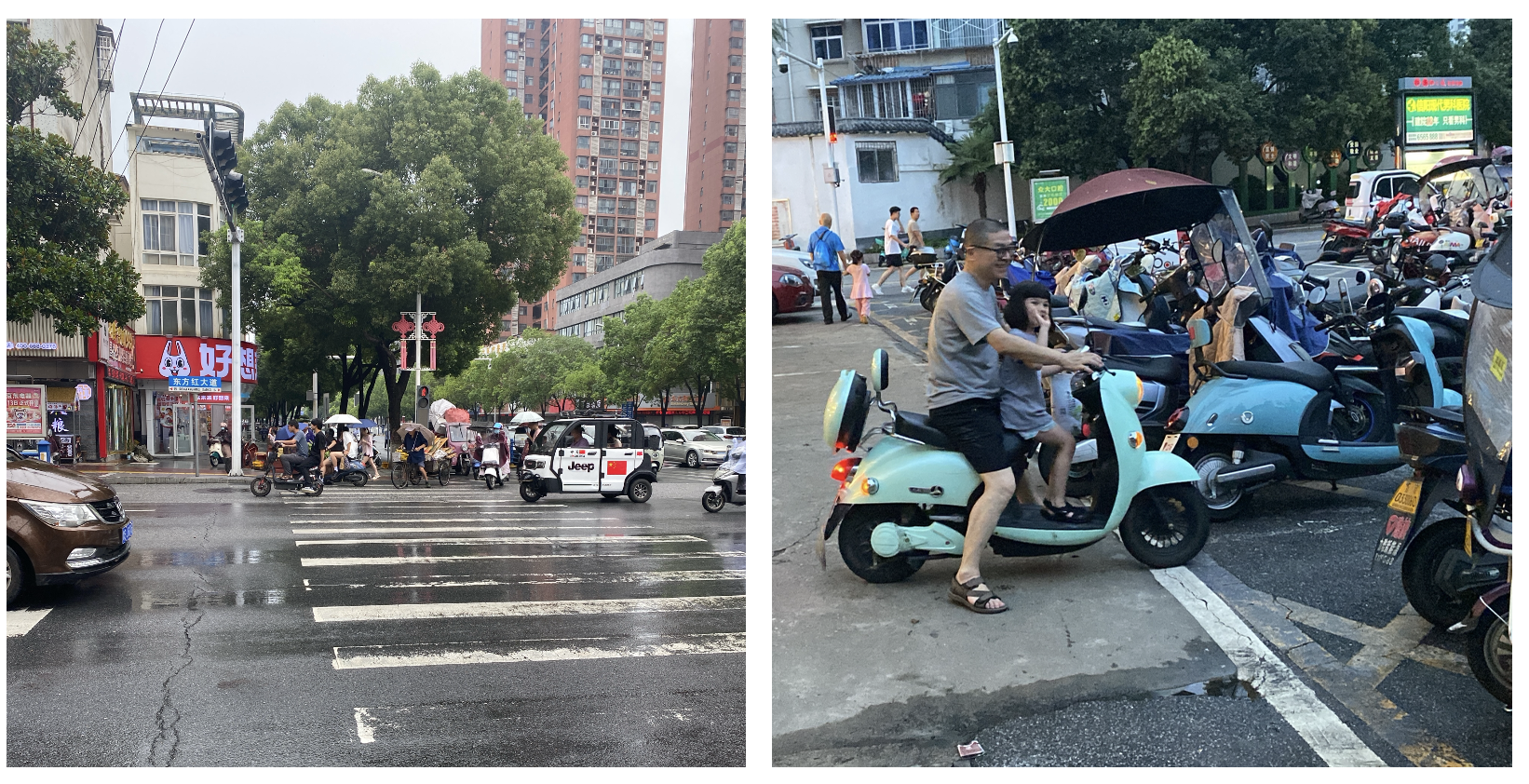
Left: Intersection outside Renfang Hutong. Right: leaving the Shihe Park.
If walk scores were a thing here, Old Xinyang would be high off the charts. My in-laws can conduct all their errands on foot, even visit most of their family and friends. Nor is this amenity prohibitively expensive. A large three-bedroom apartment that is a short walk from all manner of commerce might sell for 10x the salary of a mid-tier government official.
Xinyang grew rapidly in the 2000s as families from the Henan countryside tried to find jobs in the cities. When the time came to develop areas south of the river and in the new Yangshan “New Xinyang” district, the city made the same assumption that American cities had done a century earlier: that the future belonged to the automobile. Old Xinyang had been built when the cost burden of local travel was high. Now that constraint was lifted. The city built wide boulevards and huge “Tiananmen-style” concrete plazas. Everything was spaced further apart.
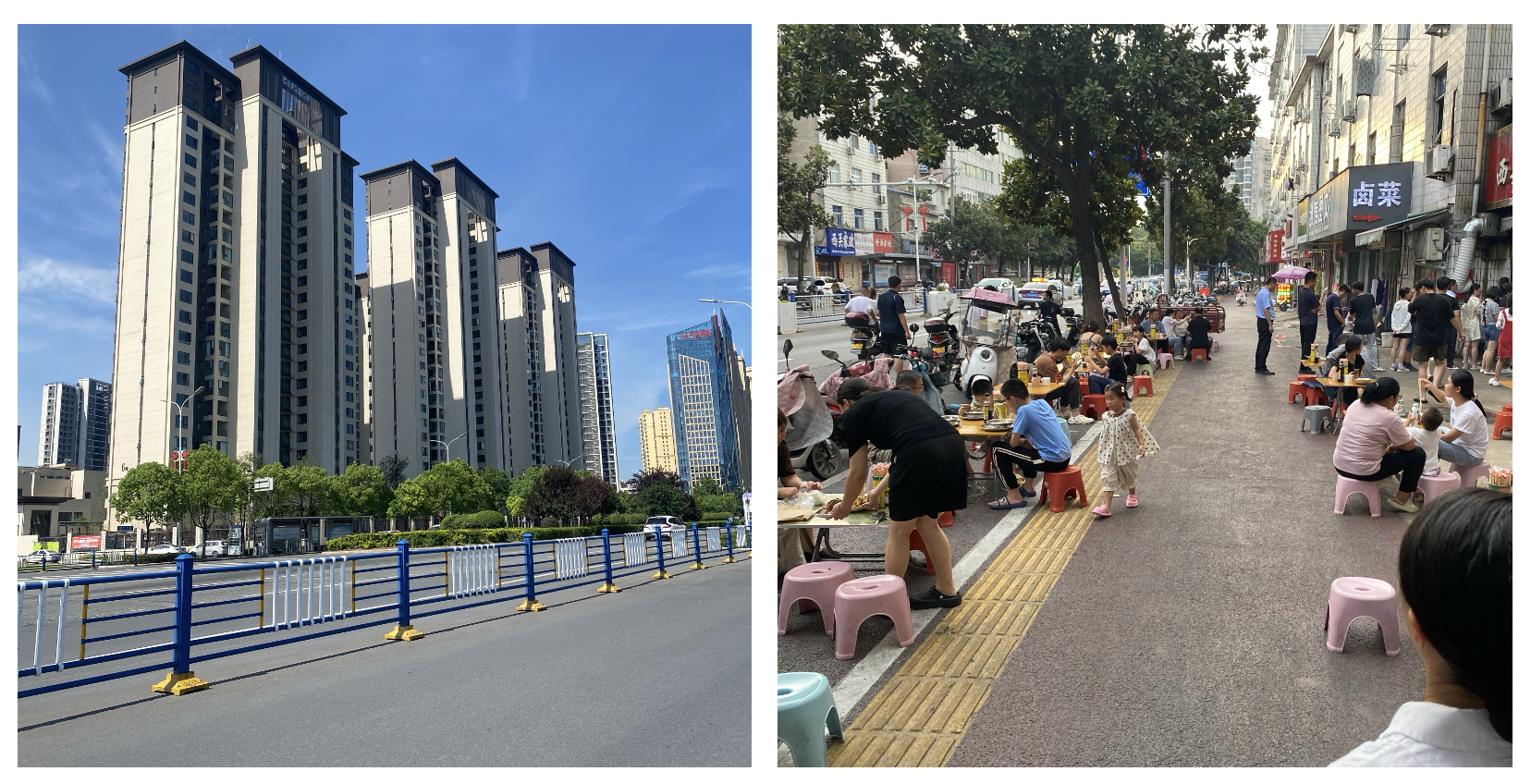
New Xinyang versus Old Xinyang
The architecture of “Old Xinyang” is a lot of six story walk-ups made of concrete. Many are U and O-shaped buildings that wrap around a central courtyard. New Xinyang apartments are 20-30 story elevator buildings with doormen. They have more amenities, better views, and ample parking. Most people still prefer Old Xinyang.
Courtyard outside the apartment.
Not just New Xinyang that has prepared for cars, Henan province has invested tremendously in new roads, bridges, signs, toll stations, and rest stops, all built in the last five years or less. There are so many new roads, that mapping services struggle to keep up. Driving around outside the city I have noticed Baidu Maps fail to recognize the existence of roads, even major ones that ramp on to highways.
Despite all this infrastructure, finding cars on the road is pretty rare. On an American highway you will encounter commuter traffic on every mile. But the drive from Xinyang to Wuhan or Zhengzhou is practically empty. There is no suburban sprawl, only dense cities surrounded by undeveloped land or farms. High speed rails connects even third tier cities to rest of the country. There are not even tractor trailers moving goods around.
Many of the cars you do find are either luxury cars or EVs. The luxury cars (Porsches, Mercedes, BMWs) are driven by young men in their twenties. They are highly effective status symbols for the job and dating markets. Owning an apartment and car is a sign of economic stability, serious business for families who still remember times when there was nothing to eat. Parents and grandparents will pool together resources to buy a luxury car for their sole male heir.
EVs have hit Xinyang streets because of China’s industrial policy. There are too many EV car brands to track: BYD, Zhiji, Zeekr, Faraday, Li Auto, X-Peng, and many more. We test drove an Aito M7 and it seemed to drive as well as Tesla, with self-driving mode, voice-commands, and massage guns in the red leather seats. It’s also significantly cheaper.
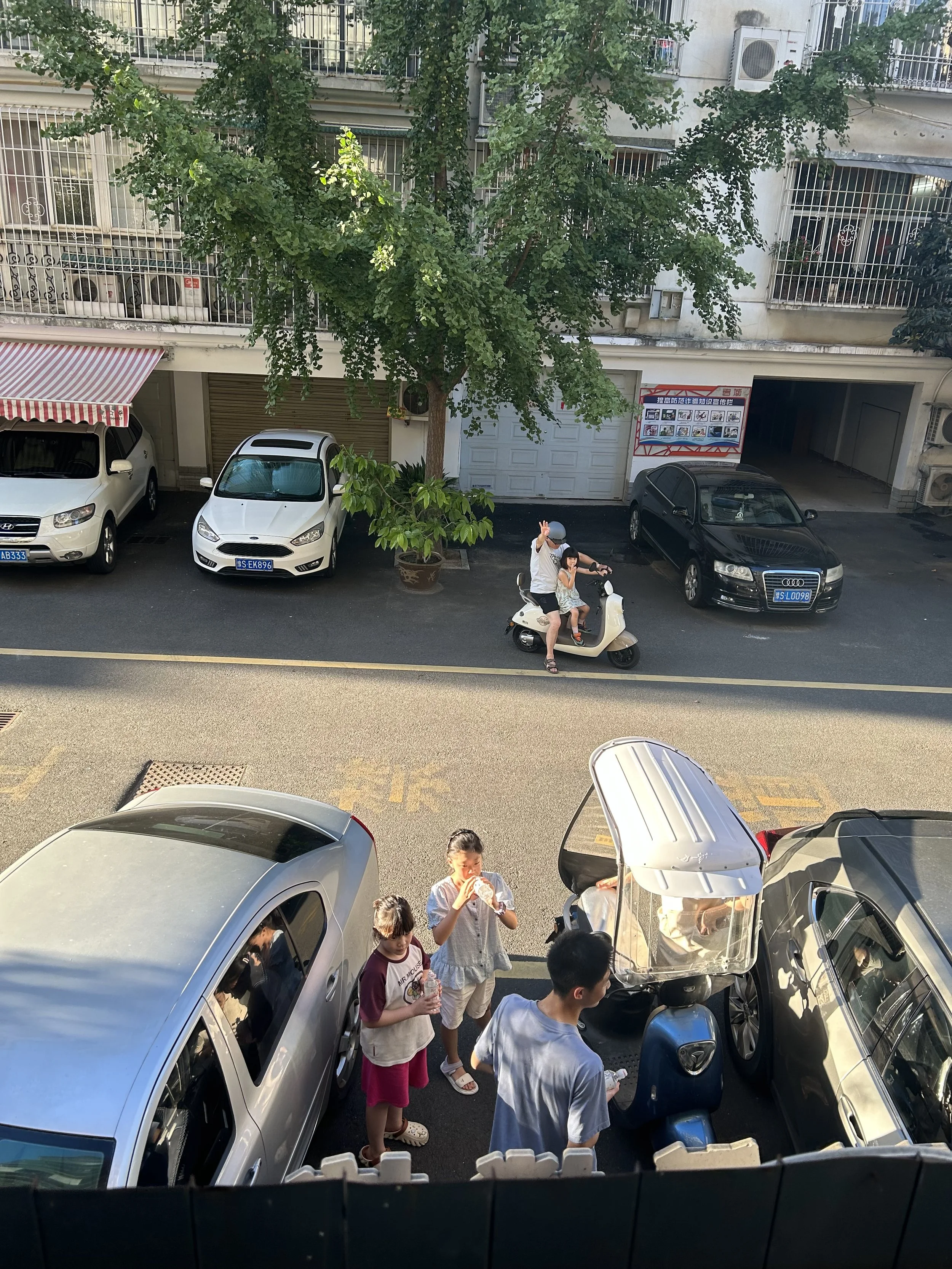
But for any car on the road there are dozens of mopeds or e-bikes. They are infinitely more practical than cars. It is much more frenetic and improvisational than the safe/slow biking in Amsterdam. Drivers can slip through dense traffic, use narrow alleys, park them anywhere. They can even drive them on sidewalks or the wrong way down one-way streets. Sometimes they are cut off from car traffic but just as often it is all in the same street. They’re also used to deliver all manner of e-commerce orders.
It’s a higher tolerance for risk. Entire families are perched on a single moped, with small children crouched on the deck between dad’s knees. Helmets are rare. Children who look as young as twelve can be seen driving their siblings around. Crossing the street in Xinyang feels like bungee jumping. Traffic will never stop or even slow for you until you step off the curb. Despite all this, Xinyang traffic does not feel more dangerous than the American style. It requires so much more concentration that people don’t drive distracted. Speeding is impossible. Accidents are less consequential when you’re on an e-bike going 20 kilometers an hour. And because there are so many bikes and mopeds on the road they create a safety in numbers that cyclists don’t have on American streets.