The High Cost of Affordable Housing
originally written/posted October 2018.
It is always getting more expensive to build affordable housing. The low income housing tax credit (LIHTC) program produces fewer units than 20 years ago (even though it costs 66% more).
Less appreciated is how much more expensive affordable housing is than market-rate housing.
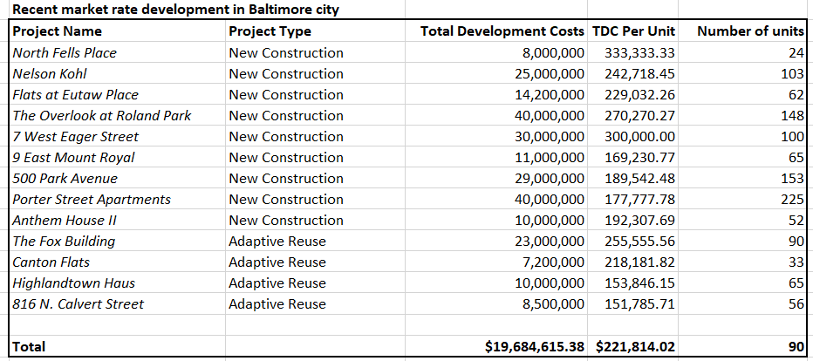
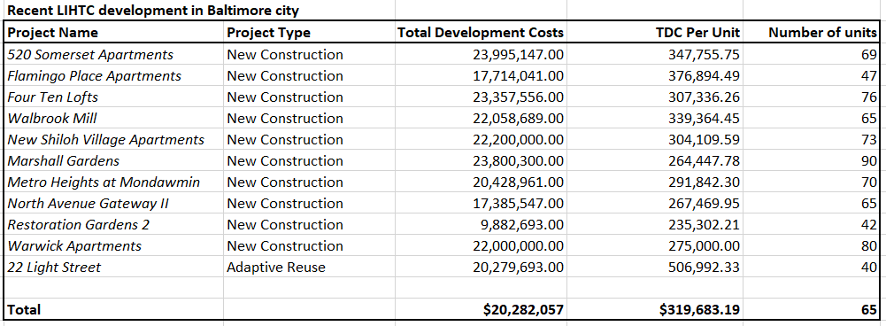
Below is an informal survey of 24 projects developed in the last 3 years or currently under construction (data collected from Daily Record, Baltimore Business Journal, Baltimore Sun, DHCD).
The summary is that average total development cost per unit (TDC/unit) was higher for affordable housing by $97,869.
Single family housing tells the same story. A review of 25 single family housing rehabs from 2014-2018 shows that affordable housing developers paid $87,500 more per house than market-rate developers.
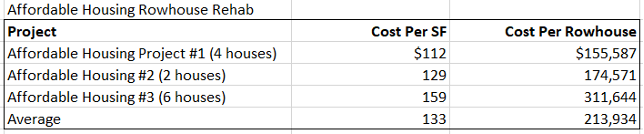
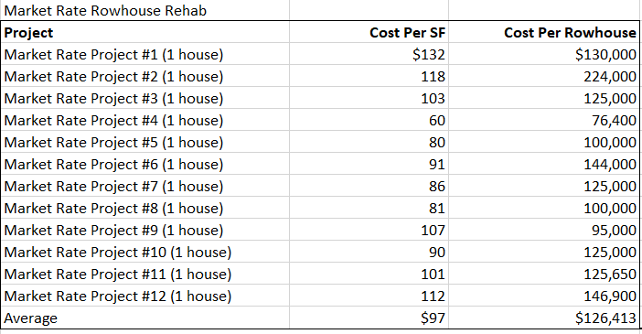
Market rate developers had to compete in more expensive neighborhoods, paid more in acquisition costs, selected more expensive finishes and amenities (completed basements, rooftop decks, parking pads, and garages) and worked scattered site without economy of scale. They were still significantly cheaper than affordable housing.
Why is it so expensive to build affordable housing?
Here are three reasons, two that I have come to accept and one that will always bother me.
Affordable housing developers cannot easily reduce costs. Market rate developers earn income from cash flow, while affordable housing developers earn developer fees. Therefore market rate developers are extremely motivated to reduce costs at every stage of development, from renegotiating with the seller to selecting work materials.
But affordable housing developers do not have the freedom or incentive to reduce costs. Once a project is awarded, developers are expected to stick to their budgets to ensure the investor gets full value of credits, including contingency. It is very difficult for a LIHTC project to come in under budget. Subcontractors and suppliers are aware of this when submitting bids. I have personally seen trades estimates that are twice as high for the equivalent scope of work in a market rate project.
Soft Costs/Financing Complexity: The fragmented, multilayered capital stack in affordable housing is a cost driver in itself. More applications, more legal work, consultant time, and underwriting iterations. In Maryland these projects often require five or more separate sources of financing, each with their own application/reporting requirements. Capital is raised independently for each project. Furthermore once a building is placed in service, the long-term rent restrictions, compliance monitoring, and affordability commitments are expensive to maintain. There is hope that this is exactly the type of problem LLMs can alleviate.
Affordable housing has an “everything bagel” problem: too many secondary objectives layered onto a program that is supposed to produce badly needed housing. Maryland’s Qualified Allocation Plan rewards LIHTC projects that place families in high-opportunity neighborhoods, locate near transit and walkable amenities, favor nonprofits, public housing authorities, and M/WBE participation, and pursue LEED or other green-building standards.
Many of these goals are admirable. But they are not free. Every added requirement raises per-unit costs and reduces the number of homes that can be built with a fixed amount of money. The tradeoff is mostly invisible. People see the project that was built with all the boxes checked; they do not see the units that were never built, or the families left unhoused as a result.
Update 3/23/26
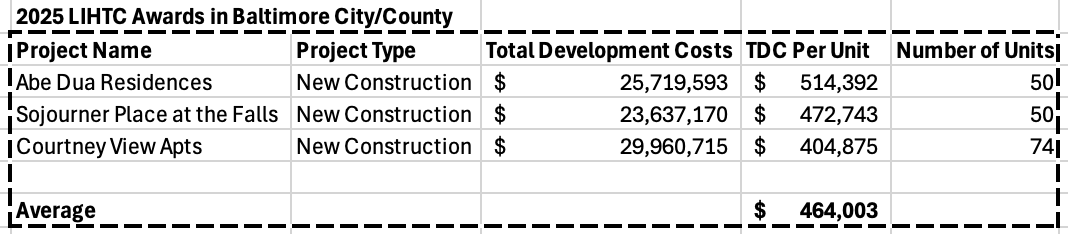
This week I was looking at the 2025 LIHTC awards. The average TDC/unit in awarded projects is now $464,003, a 32% increase in eight years.
More or less keeping up with construction costs generally.